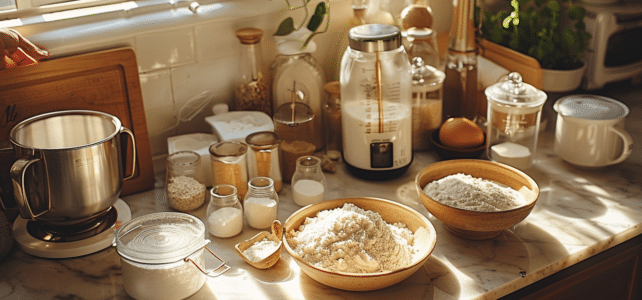
In the culinary world, precision is an art that manifests through the mastery of measurements and conversions. The secrets of converting measurements in cooking are essential for achieving recipes with balanced flavors. Whether it’s flour, a key ingredient in many preparations, or liquids that influence texture and consistency, understanding how to measure these components correctly is fundamental. These skills are even more important when adapting recipes from one culture to another, where units of measurement may vary. Mastering these conversions helps avoid mistakes and ensures the success of dishes.
Mastering Measurement Conversions for Dry Ingredients
In the precision of dosages, the digital kitchen scale stands out as an essential tool. However, cooking is often a realm of improvisation where the eye and hand replace measuring devices. The measurement conversions in cooking for dry ingredients such as flours, sugars, powders, spices, and fine herbs and seeds become a balancing act. Understand that converting, for example, 250 grams of flour into cups requires not only a conversion chart but also a good knowledge of the product. Flour, being volatile and compactable, does not lend itself to approximations.
Recipes expressed in imperial units, such as cups or tablespoons, coexist with those in grams, which come from the metric measurement system. To navigate between these systems, keep a conversion chart handy. One cup of sugar is equivalent to 200 grams, while a tablespoon of flour represents 15 grams. These measurements are reliable for dry ingredients, provided that the filling method is uniform and without packing.
Spices and herbs, often measured with more delicacy, follow a different logic: a teaspoon equals 3 grams, while a tablespoon for fine herbs and seeds amounts to 10 grams. The precision of these quantities is essential for the final taste of the dish. A scale, even a digital one, proves indispensable for maintaining the subtle balance of flavors.
Converting measurements for dry ingredients is a skill to hone. Take the time to understand the weight of each ingredient, familiarize yourself with the conversions between metric and imperial systems, and grasp the correspondence of cups, tablespoons, and grams. Precision in these basic cooking gestures ensures the success and consistency of prepared recipes, whether they stem from ancestral traditions or contemporary innovations.
Understanding and Applying Measurement Conversions for Liquids
Modern cooking requires a deep understanding of measurement conversions for liquids, whether it’s oils, syrupy liquids, or creams. The measuring cup, often overlooked, proves to be a significant ally, displaying graduations for various ingredients. Indeed, the measuring cup is not just a container but a precise guide that indicates quantities for liquids, adjusted for flour, sugar, and rice.
The distinction between volume and weight becomes apparent when measuring liquids. Be aware that 1 tablespoon of oil is approximately 12 milliliters, while the same measure in syrupy liquid counts as 5 milliliters. This precision is crucial, as variations affect the texture and taste of your preparations. Hence, measuring accurately with a kitchen scale for thick liquids like sauces or creams is useful.
Traditional recipes, such as yogurt cake, sometimes use atypical measuring tools. The yogurt pot, for example, serves as a reference measure for both dry and liquid ingredients, giving the recipe simplicity and authenticity. For a faithful and consistent reproduction, you need to translate these measures into grams or milliliters using a conversion chart.
The kitchen scale plays a fundamental role in the transposition of measurement units. Water, for instance, follows a simple conversion: 1 milliliter of water weighs 1 gram. Denser liquids, like creams and yogurts, require an adjustment, with one cup potentially weighing up to 250 grams. Mastering these nuances ensures the rigor necessary for the success of cooking recipes.